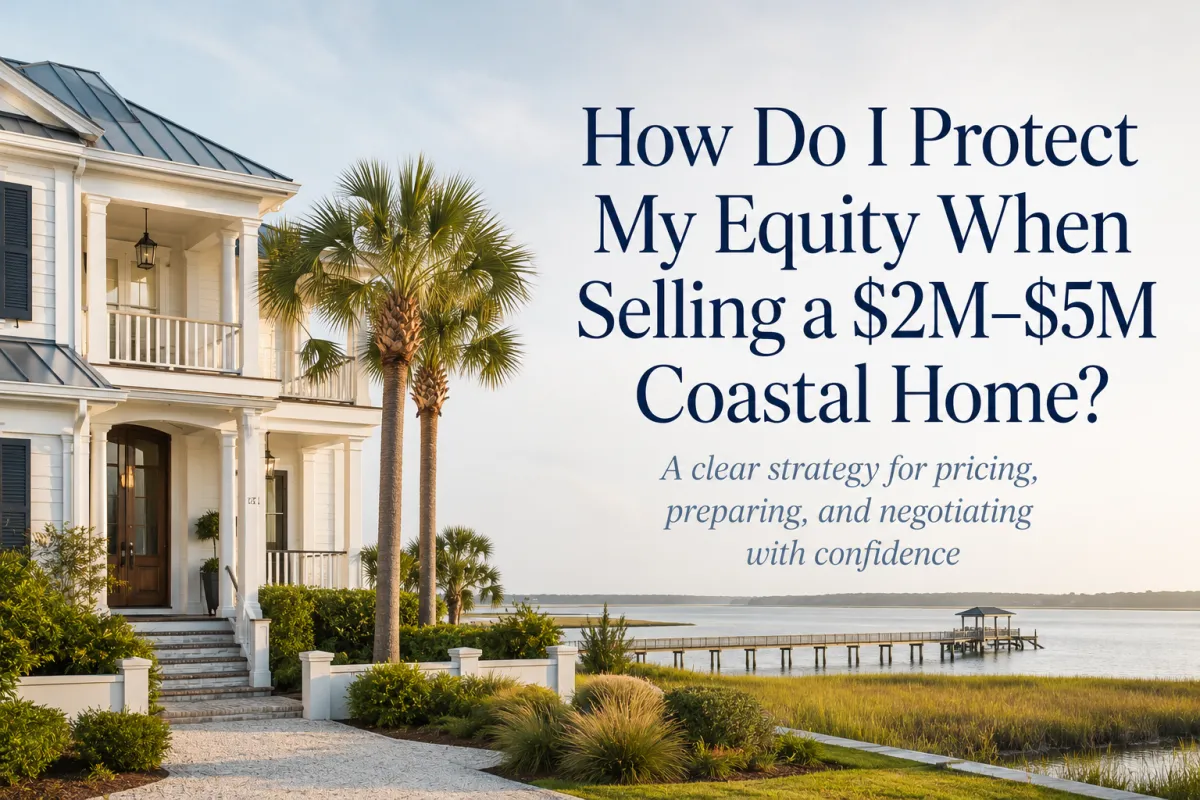
How Do I Protect My Equity When Selling a $2M–$5M Coastal Home?
How Do I Protect My Equity When Selling a $2M–$5M Coastal Home?
If you’re thinking about selling a $2M–$5M coastal home, your equity deserves more than a quick listing plan.
At this price point, small decisions can make a big difference.
A pricing mistake, weak preparation plan, poor negotiation, or wrong buyer strategy can affect your final net. Not just by a little.
The short answer is this:
You protect your equity by pricing carefully, preparing strategically, positioning the home correctly, and negotiating beyond just the sale price.
A high-value coastal home needs more than exposure.
It needs a plan.
Start With the Real Number
A lot of sellers focus on the sale price first.
That makes sense.
But sale price is not the same as what you walk away with.
Before you make decisions, you need to understand your likely net proceeds.
That means looking at:
Realistic sale price range
Mortgage payoff, if any
Seller closing costs
Preparation costs
Repair costs
Potential concessions
Timing needs
Your next move
This is where clarity matters.
A $2M–$5M coastal home may have strong value, but that does not mean every dollar is protected automatically.
Your equity is protected by the strategy around the sale.
Not just the price on the listing.
Do Not Guess on Pricing
Pricing is one of the biggest equity decisions you will make.
If the home is priced too high, it can sit. Then buyers start asking questions.
Why hasn’t it sold?
Will the seller negotiate?
Is something wrong?
If the home is priced too low without a strategy, you may leave money on the table.
The right price should be based on real market context, not emotion, hope, or a neighbor’s opinion.
For coastal homes, that context includes:
Location
Lot size
Beach or water access
Views
Elevation
Flood considerations
Condition
Outdoor living
Privacy
Buyer demand
Current competition
In Isle of Palms, Mount Pleasant, Sullivan’s Island, and Coastal Charleston, two homes can look similar online and perform very differently in the market.
That is why a careful pricing conversation matters.
Prepare the Home Without Overspending
One of the fastest ways to lose equity is to spend money in the wrong places before listing.
A lot of sellers think they need to fix everything.
They don’t.
Some updates help. Some do not. Some repairs protect your position. Others become expensive distractions.
Before you spend money, ask:
Will this help the sale?
Will buyers care?
Will it improve presentation?
Will it reduce objections?
Will it protect us during inspection?
Will we likely see the money come back?
For a high-value coastal home, preparation may include fresh paint, landscaping, pressure washing, window cleaning, minor repairs, staging, lighting updates, or getting outdoor spaces photo-ready.
But a full renovation is not always the right move.
Not every update is worth doing.
We focus on what protects your equity.
Position the Home for the Right Buyer
Exposure is not the same as positioning.
Anyone can put a home online.
That does not mean the right buyer understands why it matters.
A high-value coastal home needs a clear buyer story.
That story may be about beach access, privacy, outdoor living, family gatherings, water views, walkability, convenience, island lifestyle, or long-term value.
The point is not to hype the home.
The point is to help the right buyer understand the value.
On Isle of Palms, buyers may care about beach access, lifestyle, condition, and flexibility.
In Mount Pleasant, they may care about space, convenience, neighborhood feel, and long-term value.
On Sullivan’s Island, homes are not generic. The marketing should not be either.
When the home is positioned clearly, buyers have a stronger reason to act.
That can protect your price and your negotiating power.
Pay Attention to Terms, Not Just Price
The highest offer is not always the best offer.
This is especially true when selling a high-value coastal home.
A strong offer should be reviewed carefully.
Price matters, but so do:
Financing strength
Cash vs. financed offer
Appraisal risk
Inspection terms
Closing timeline
Earnest money
Contingencies
Repair requests
Buyer motivation
Certainty of closing
A buyer may offer a strong price but carry more risk.
Another buyer may offer slightly less but give better terms, fewer contingencies, and a smoother closing.
That difference matters.
Getting an offer is one step.
Negotiating the right terms is where experience matters.
Protect Yourself During Inspection
Inspection can become a second negotiation.
That is why it should be part of the equity strategy from the beginning.
If there are known issues, talk through them before listing.
Should they be repaired?
Should they be disclosed and priced accordingly?
Should you get estimates first?
Should you wait and negotiate later?
There is no one right answer for every home.
But ignoring known issues can weaken your position.
Buyers may use inspection findings to ask for credits, repairs, or price reductions. Sometimes those requests are reasonable. Sometimes they are not.
The stronger your preparation and documentation, the better you can respond.
Watch the Timeline
Timing affects equity too.
If you need to sell quickly, the strategy may be different.
If you have time to prepare carefully, that may strengthen your position.
If you are downsizing, relocating, handling probate, going through divorce, or managing a private transition, your timeline matters even more.
The sale plan should support your next move.
Not create pressure.
Waiting can be smart when it gives you time to prepare, align decision-makers, or protect privacy.
But waiting without a plan is just guessing.
You do not need to rush.
You need the right plan.
A Simple Example
Let’s say a homeowner in Isle of Palms is thinking about selling a high-value coastal home.
The home has strong location and lifestyle appeal, but it needs some light preparation. The seller is considering a larger renovation before listing.
Before spending that money, the smarter move is to review the likely buyer, recent sales, current competition, and what improvements would actually affect value.
The best plan may not be a renovation.
It may be targeted paint, landscape cleanup, professional staging, strong photography, and clear positioning around beach access and outdoor living.
That kind of strategy can help the home show well without draining equity before the sale even begins.
Common Mistakes Sellers Make
One mistake is overpricing because of emotion.
Another is spending too much before listing.
Another is choosing the highest offer without reviewing the risk behind it.
Another is treating marketing like exposure instead of positioning.
Another is waiting too long to create a plan.
These mistakes are common.
They are also avoidable.
When you are selling a $2M–$5M coastal home, you do not need guesswork.
You need clear guidance.
So, How Do You Protect Your Equity?
Start with the numbers.
Then look at the home.
Then review the buyer.
Then decide what preparation makes sense.
Then price carefully.
Then negotiate the full offer, not just the headline number.
That is how equity is protected.
Not by pressure.
Not by hype.
By strategy.
FAQs
How do I protect my equity when selling a high-value coastal home?
Start with a clear pricing strategy, avoid unnecessary prep costs, position the home for the right buyer, and negotiate terms carefully.
Should I renovate before selling a $2M–$5M coastal home?
Not always. Some updates help, but major renovations can be expensive and may not return enough value. Get a strategy before spending money.
Is the highest offer always the best offer?
No. Terms, contingencies, financing, inspection risk, appraisal risk, closing timeline, and buyer strength all matter.
What affects the value of a coastal home?
Location, condition, beach or water access, views, elevation, flood considerations, outdoor living, privacy, and buyer demand all matter.
When should I start planning before selling?
Earlier than you think. A planning conversation can help you understand your equity, preparation needs, timeline, and likely next steps before you list.
Final Thoughts
Selling a $2M–$5M coastal home is not just about getting attention.
It is about protecting what you have built.
Your equity deserves careful pricing, thoughtful preparation, strong positioning, and skilled negotiation.
Start with the plan.
Then move forward with clarity.
Tina Fields
Realtor with The Fields Group
Serving Isle of Palms, Mount Pleasant, Sullivan’s Island & Coastal Charleston, SC
Helping coastal Charleston homeowners sell with strategy and confidence
TinaFields.com | 843-737-2438